
St. John Parish Criminal Court Records
A criminal court record in St. John the Baptist Parish is the court case file kept by the Clerk of Court after a prosecution is filed. The clerk criminal department is tied to criminal filings, expungement forms, criminal costs, faxed-copy information, and the local instruction that expungement filers need sheriff fingerprints and an arrest report. The sheriff documents arrest and booking events, while the District Attorney decides and prosecutes charges. The clerk keeps the court file.
The 40th Judicial District Court hears felonies and misdemeanors for St. John the Baptist Parish. The local court is divided into Divisions A, B, and C. Division pages identify the judges, minute clerks, felony and misdemeanor assistant district attorneys, and public defender assignments. A criminal court file may therefore show the court division, judge, minute entries, prosecutor, defense counsel, charge, plea, disposition, sentence, fines, fees, restitution, and probation terms.
The manifest image from the St. John clerk criminal department is the best local image for the court-file side of criminal records.
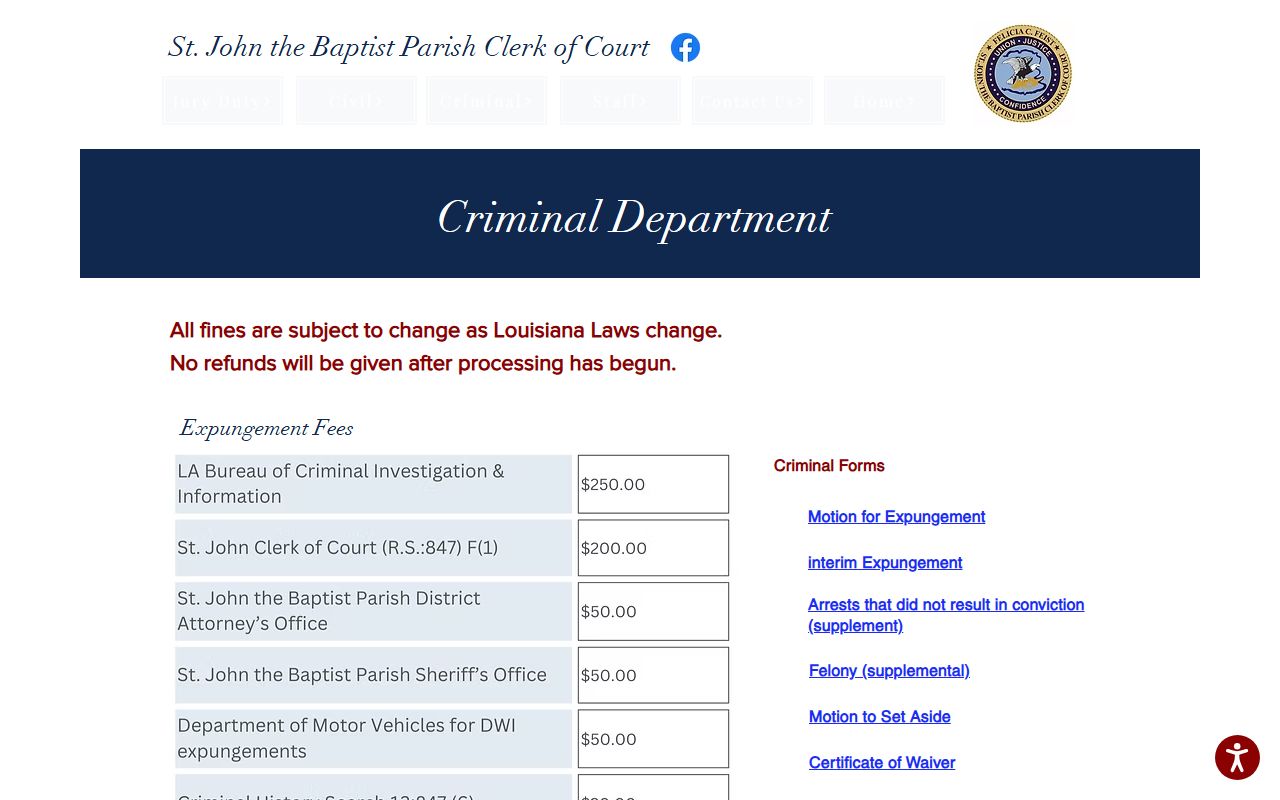
Use that office for court records and expungement filing steps, not as a substitute for legal advice or sheriff custody data.
Search St. John Parish Criminal Cases
Criminal case lookup follows the same clerk-centered path as other St. John the Baptist Parish court records. Start with Clerk Connect or eClerks LA when the criminal case category is enabled for the parish. If the portal does not show the case, contact the clerk by phone, mail, email, fax, or office visit. For hearing date or division procedure, use the 40th JDC division contacts or court schedule.
- Search by defendant name or case number when the clerk portal supports the criminal case module.
- Check the court division and judge before relying on a hearing date or minute entry.
- Read the charge list and docket entries in order, from filing through disposition.
- Request certified copies from the Clerk of Court when a plea, sentence, judgment, or expungement filing requires proof.
- Use the sheriff inmate portal, LAVNS, or the sheriff app only for custody or booking status, not for the full court case file.
A charge-specific discussion belongs with St. John the Baptist Parish arrest records and court charges, while broader civil, probate, family, and traffic records belong with general St. John the Baptist Parish court records.
St. John Parish Criminal Case Flow
Criminal court records become easier to read when each entry is tied to the stage of the case. The arrest may create a booking record, but the court file grows when a charging document and court events appear. The local research identifies bills of information and indictments as possible charging documents, plus arraignment, bond, motions, pleas, minute entries, dispositions, sentencing, fines, costs, probation, and orders.
Case flow: Charges Filed › Arraignment › Pretrial / Motions › Plea or Trial › Disposition › Sentencing
| Stage | What Happens |
|---|---|
| Charges filed | The DA proceeds by a court charging document, such as a bill of information or indictment. |
| Arraignment | The defendant is formally called on the charge and a plea may be entered. |
| Pretrial / motions | The docket may show bond, continuances, motions, orders, discovery issues, or hearing resets. |
| Plea or trial | The record may show a guilty plea, not-guilty finding, trial result, dismissal, or acquittal. |
| Disposition and sentence | The final charge outcome, sentence, probation terms, fines, costs, or restitution may be entered. |
What St. John Criminal Records Show
Because no public sample 40th JDC criminal case record was viewable in the research without account access or dynamic portal interaction, the field inventory stays conservative. These are the fields the research supports for a criminal case file, not a promise that every public screen displays each item.
| Field | What It Shows |
|---|---|
| Case number | The court file identifier. The exact local format was not located in official text. |
| Division and judge | Division A, B, or C and the assigned 40th JDC judge. |
| Defendant and counsel | The accused person and attorney or public defender assignment when listed. |
| Charges | The offense label, statute reference when shown, and the charging instrument. |
| Docket entries | Arraignment, motions, hearings, continuances, plea dates, trial dates, and minute entries. |
| Disposition | Guilty, dismissed, acquitted, reduced, amended, nolle prosequi, or other outcome when entered. |
| Sentence | Jail or prison term, probation, fines, fees, restitution, and court orders when public. |
Charges vs. Convictions
A charge is an accusation filed into the court record. A conviction is a final guilty outcome through plea or verdict. St. John the Baptist Parish criminal court records may show charges that were amended, reduced, dismissed, or ended in acquittal. Read the disposition for each count instead of assuming every charge became a conviction.
| Charge | Conviction | |
|---|---|---|
| Meaning | A formal accusation filed after arrest or investigation | A guilty plea or verdict entered by the court |
| Where it appears | Bill of information, indictment, docket, or case file | Disposition, plea entry, sentencing entry, or judgment |
| Public access | Often public, subject to sealing, juvenile rules, and investigatory limits | Often public unless sealed, expunged, juvenile, or restricted by law |
Public St. John Criminal Records
Louisiana public-record law applies, but criminal records have extra limits. La. R.S. 44:3 restricts some criminal investigatory records while keeping initial reports, bookings, summons or citations, and bills of information public. That distinction explains why an arrest report, a booking, and a court case file may be held by different offices and released under different rules.
The manifest image for Louisiana's criminal investigatory records exception is central to criminal court record access in St. John the Baptist Parish.
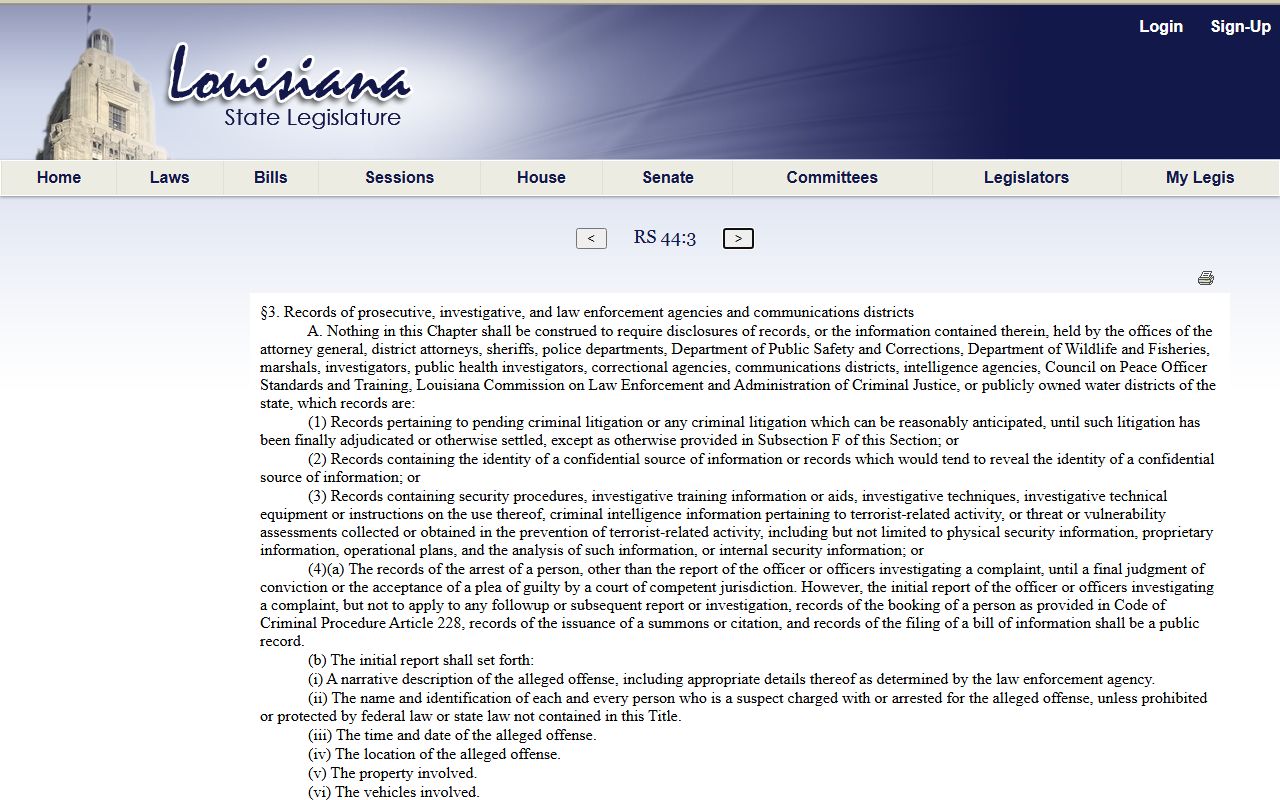
That law is why public criminal court records can include filed charges while some investigative material remains withheld.
Note: Juvenile court records are confidential under Louisiana Children's Code Article 412 unless access is specifically authorized.
Sealed vs. Expunged Records
Sealing and expungement restrict public view of criminal court records, but Louisiana expungement does not always destroy every agency record. The clerk criminal page says expungement forms must be completed before filing and clerk staff cannot help fill them out. It also says the applicant needs sheriff fingerprints and an arrest report for the local filing package.
| Sealed | Expunged | |
|---|---|---|
| Public visibility | Removed from ordinary public view by law or court order | Public access is restricted under the expungement order and statute |
| Local process | Depends on the court order and record type | Uses clerk forms, sheriff fingerprints, and arrest report when required |
| Eligibility | Depends on case type and law | Article 976 covers some arrests that did not result in conviction |
The manifest image for Louisiana Code of Criminal Procedure Article 976 connects St. John expungement questions to the state rule for arrests not resulting in conviction.
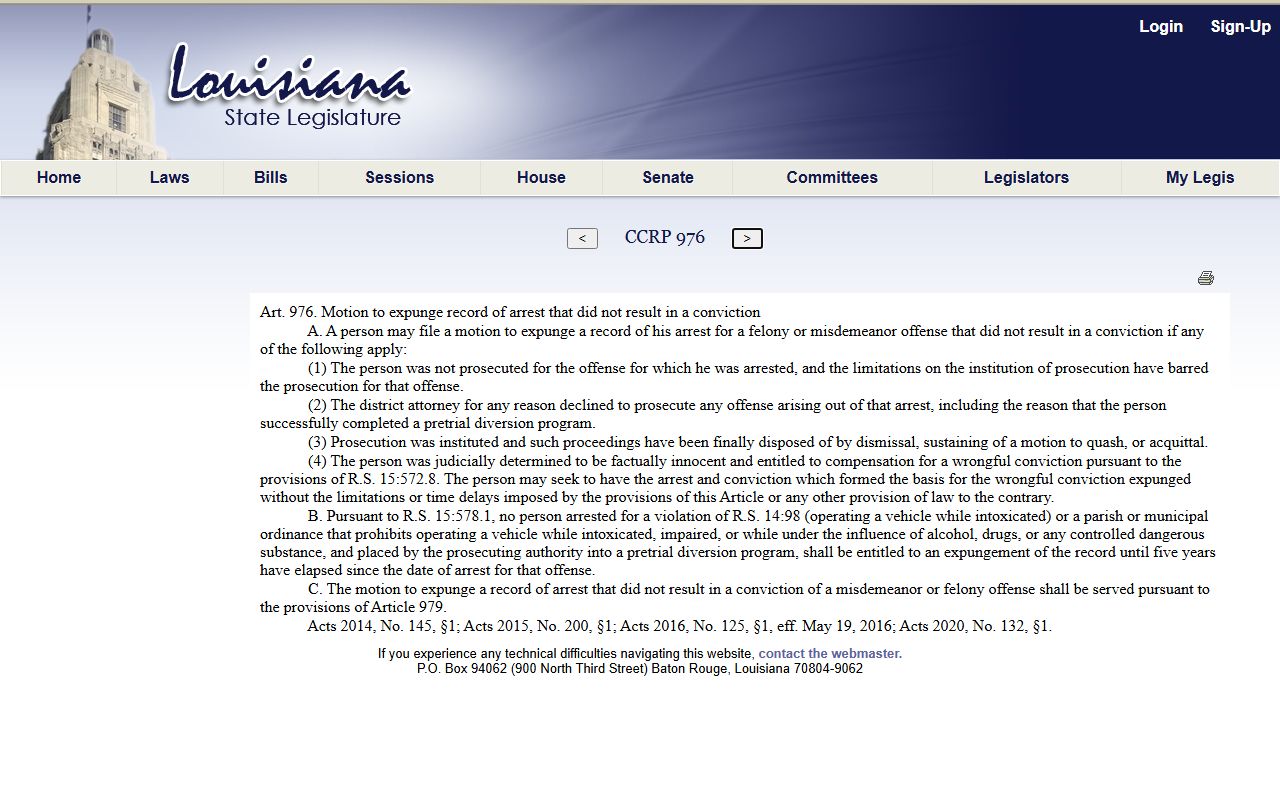
Article 976 is one eligibility path, while the clerk forms control the local filing packet presented in St. John the Baptist Parish.
The manifest also includes Article 985.2 on automated expungement, with the process beginning January 1, 2025 for qualifying records.
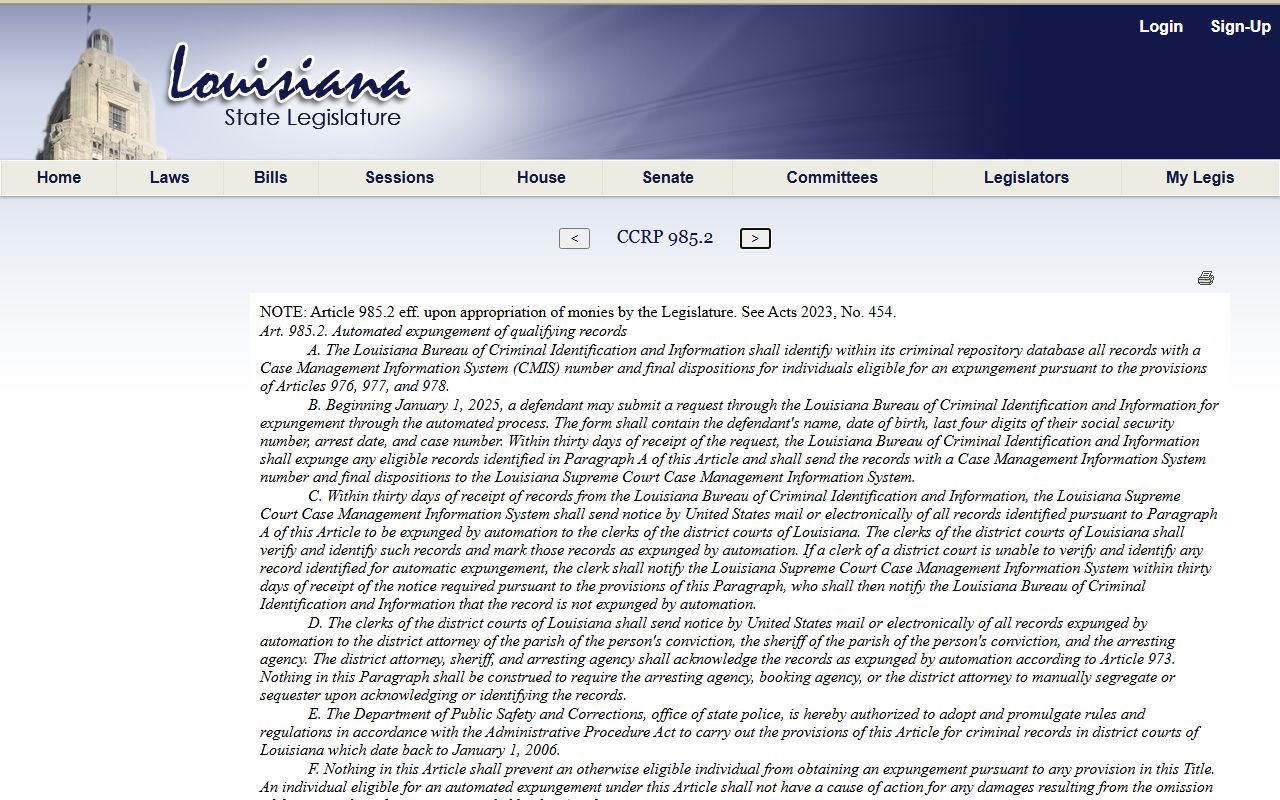
Automated expungement is limited to qualifying records with the required state data, so older or incomplete cases may still need the clerk filing path.
DA and Defense Record Context
The 40th Judicial District Attorney is Bridget A. Dinvaut. The DA office lists felony, misdemeanor, juvenile justice, child support enforcement, victim services, worthless checks, civil division, Drug Court, Traffic Court, Juvenile Diversion, and Misdemeanor/Felony Diversion resources. Prosecutor decisions shape charges, amendments, dismissals, pleas, and diversion paths that may later appear in the court file.
The St. John the Baptist Public Defender Office provides court appointed lawyers in the 40th Judicial District. Its office is at 75 Dominican Rd., Suite 202, LaPlace, with telephone 985-651-6677, fax 985-651-5800, and custodian of records Fontella Baker. The homepage states that an appointment is required for all in-office visits.
The manifest image from the public defender site shows a defense-side office that may appear in criminal court records through counsel entries and appointment references.
Public defender records are not the same as court records, but attorney assignments help readers interpret who appeared in the criminal case file.