
St. John Parish Arrest Records and Charges
St. John the Baptist Parish arrest records and court charge records are linked, but they are not the same file. The Sheriff's Office documents arrest, booking, custody, public records, inmate data, most wanted information, and the app features tied to inmates and warrants. The District Attorney decides and prosecutes charges. The Clerk of Court keeps the charging instrument and the court case file once formal charges are filed.
The sheriff is Michael "Mike" Tregre, and the Sheriff's Office lists its main address as 1801 West Airline Hwy., LaPlace, LA 70068, with phone 985-652-9513 and emergency 911. The sheriff biography says he began as sheriff July 1, 2012 and began his fourth term July 1, 2024. Those sheriff records are useful for the arrest side, while St. John the Baptist Parish criminal court records show the full court case and outcome.
The manifest image from Sheriff Michael Tregre's biography identifies the local sheriff connected to arrest and booking records.
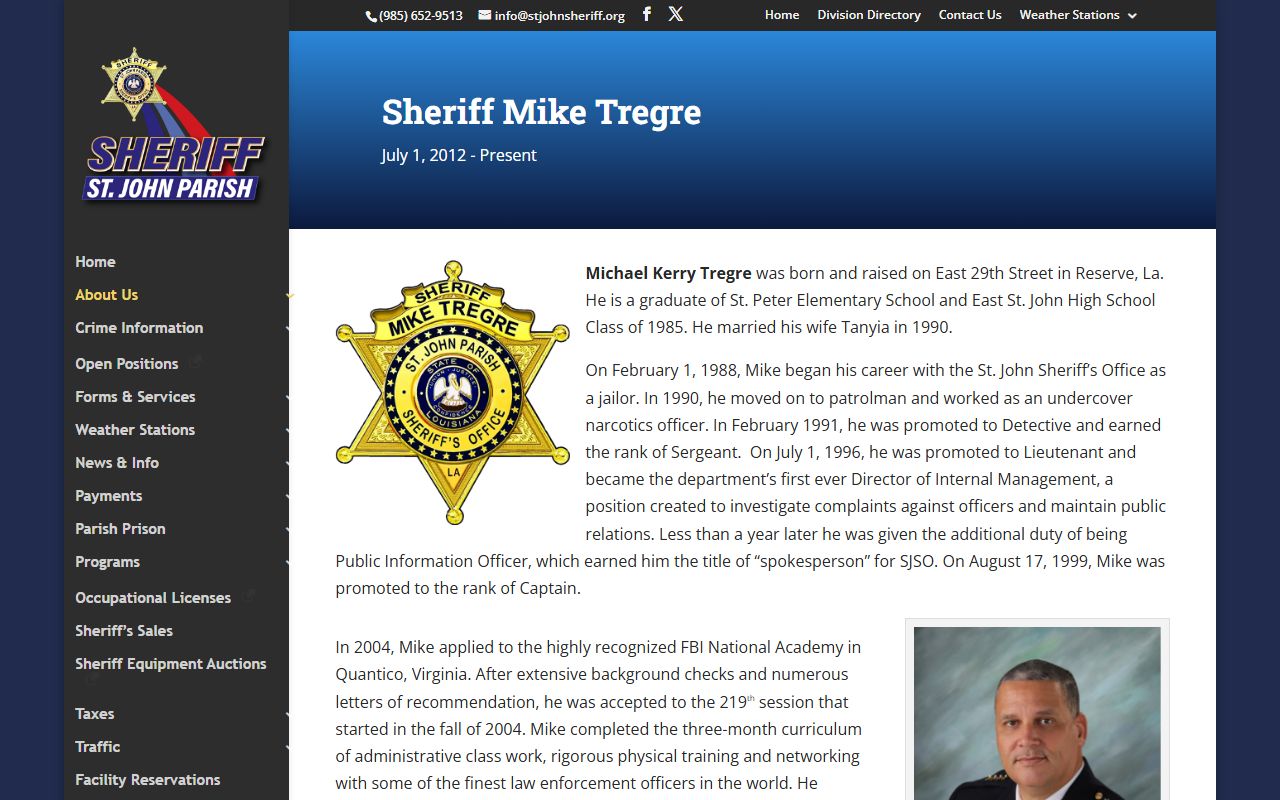
Use the sheriff path for arrest-side records and the clerk path for the court charges filed after arrest.
Find St. John Arrest Records
Start with the record type. If the question is current custody or booking status, use the sheriff-linked Zuercher inmate portal, LAVNS/VINELink, the sheriff app, or sheriff public records. If the question is the formal charge filed in court, use the clerk's criminal case channels. If the question is prosecution or diversion, the DA site may provide context, but the filed court record remains with the clerk.
- Check the sheriff inmate or LAVNS channel for booking, custody, transfer, release, escape, or death transaction data.
- Use the sheriff public-record process for arrest reports or records not shown online.
- Search the clerk's case channels for the bill of information, indictment, charge, plea, docket, and disposition.
- Call the relevant 40th JDC division or clerk when a hearing date, warrant, or bench warrant is tied to court.
- Confirm each charge's current status before treating it as a conviction or final outcome.
The sheriff's division directory is assigned in the manifest because it documents sheriff operating units and direct numbers relevant to arrest-side questions.
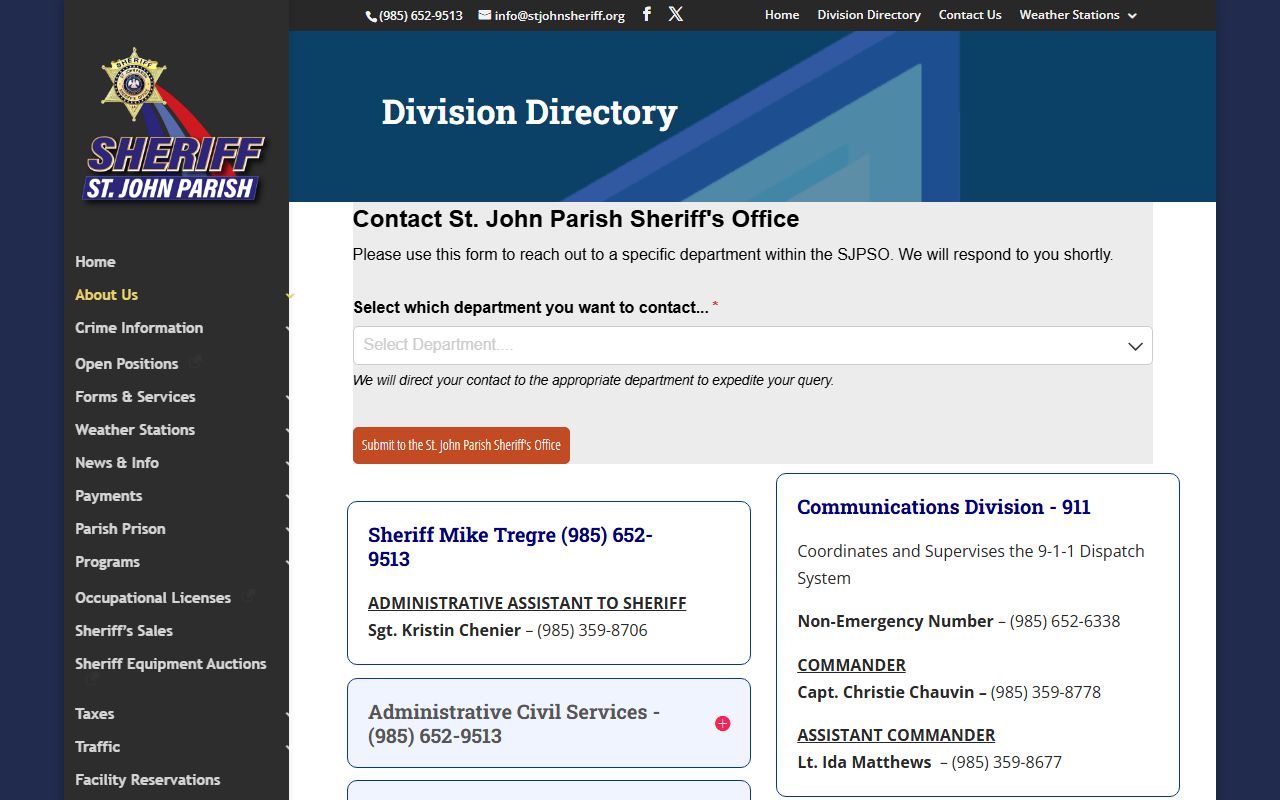
Administrative Civil Services, tickets, bonds, fines, and criminal investigation contacts can help route a request to the correct sheriff function.
Court Charges After Arrest
Charges after arrest are the formal accusations placed into the court process. Louisiana and local research supports bills of information and indictments in criminal case files, with the DA as the office that decides and prosecutes charges. A complaint, information, or indictment starts or frames a charge, but the exact document should be confirmed from the clerk's court file.
| Complaint | Information | Indictment | |
|---|---|---|---|
| Filed by | Law enforcement or prosecutor, depending on context | Prosecutor | Grand jury |
| Use in record | May start or support an accusation | Common Louisiana charging document, called a bill of information | Grand-jury charging document |
| What to verify | Arrest report and court filing status | Charge, statute, count, and amendment history | Charge, count, and court case status |
St. John Charge Status
One arrest can lead to no charges, one charge, or several charges. Charges can also change after the first filing. They may be amended, reduced, added, dropped, dismissed, or resolved through plea or trial. La. R.S. 44:3 keeps bookings, summons or citations, and bills of information public while limiting some criminal investigatory records, so the public charge record may not include the full investigative file.
| Status | What It Means |
|---|---|
| Pending | The charge has not reached final disposition in the court record. |
| Amended | The filed charge changed, often by count, statute, or wording. |
| Reduced | The charge level or offense changed to a lesser charge. |
| Dismissed | The court record shows the charge was dismissed. |
| Nolle prosequi | The prosecution declined to proceed on that charge. |
| Disposed | The record shows a final outcome, such as plea, verdict, dismissal, or sentence. |
Charges vs. Convictions
A court charge is an allegation. A conviction is a guilty result. St. John the Baptist Parish arrest records may show an arrest, and the court file may show charges, but the disposition controls whether a charge became a conviction. Read count by count because one case can contain dismissed charges, amended charges, and one or more convictions.
| Charge | Conviction | |
|---|---|---|
| Record stage | After arrest or investigation, when the prosecutor files the accusation | After plea or verdict |
| Meaning | The person is accused of an offense | The court records a guilty outcome |
| Where to look | Bill of information, indictment, docket, and charge list | Disposition, plea entry, sentence, and judgment |
Sheriff Arrest Record Channels
The sheriff public-records page says requests are handled by Sheriff Mike Tregre. Written requests may be mailed to St. John the Baptist Parish Sheriff's Office, P.O. Box 1600, LaPlace, LA 70069, or emailed to records.request@stjohnsheriff.org. Use that path when the sought record is a sheriff arrest report or law-enforcement record rather than a court filing.
The manifest image from the sheriff public-records page documents the written request channel for St. John the Baptist Parish arrest records.
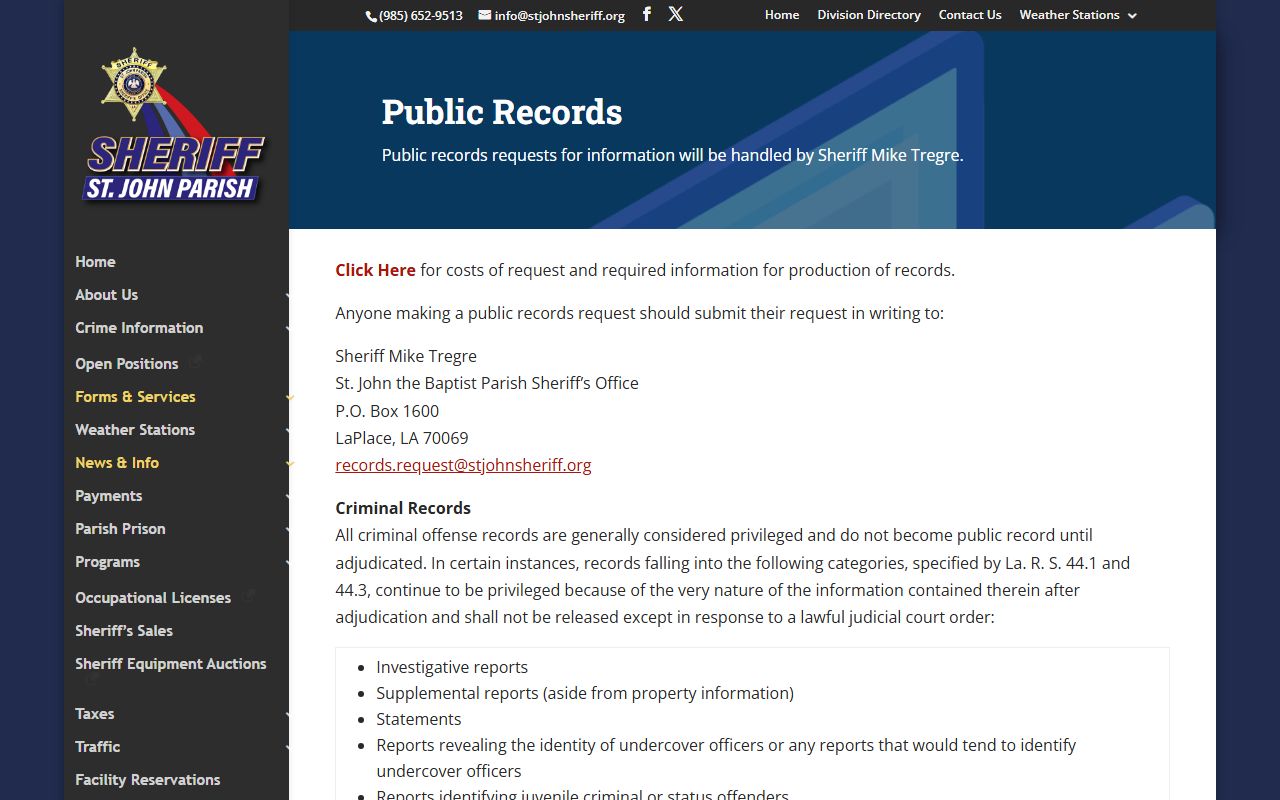
That request route is separate from certified clerk copies and separate from parish-government administrative records.
St. John the Baptist Parish Sheriff's Office
1801 West Airline Hwy.
LaPlace, LA 70068
985-652-9513
Public records by mail: P.O. Box 1600, LaPlace, LA 70069
Booking and LAVNS Context
For custody status, the sheriff links St. John Parish inmates to a Zuercher public portal. The sheriff's LAVNS page says St. John Parish is online with LAVNS and supplies booking information to VINELink. LAVNS collects offender transaction data from all 64 parish jail systems, the Department of Corrections, and the Louisiana District Attorneys Association around the clock.
Offender transactions described in the research include intakes, bookings, transfers, releases, escapes, and deaths. LAVNS can send automatic notifications to registered users. Louisiana DPS&C also says searches may use location, name, ID, or case number, with state-prison and probation/parole data updated every 24 hours.
The manifest image for the sheriff LAVNS information page connects arrest and booking status to victim-notification data.
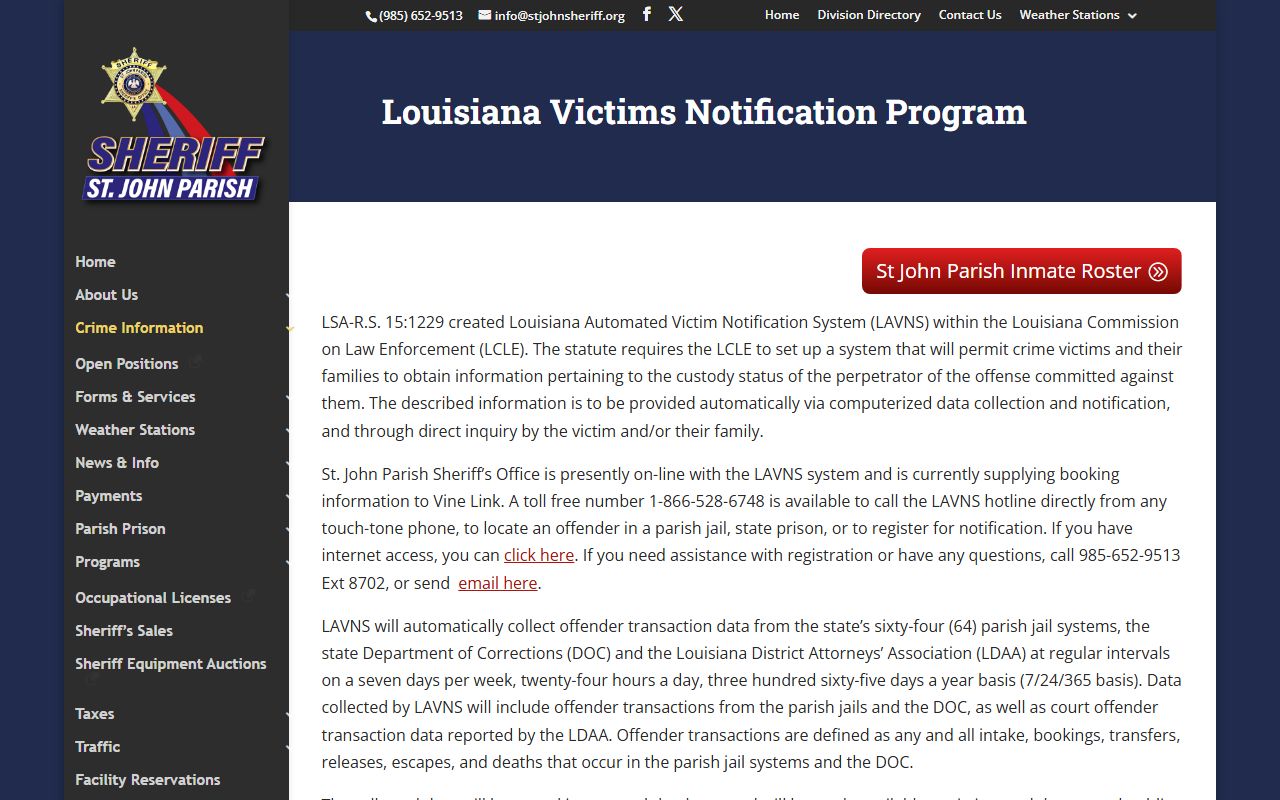
LAVNS is useful for custody and transaction status, while the court charge record must still be read through the clerk and court case file.
DA and Public Defender Roles
The District Attorney is Bridget A. Dinvaut for the 40th Judicial District. The DA homepage lists offices in Edgard and Reserve, with felony, misdemeanor, juvenile justice, child support enforcement, victim services, worthless checks, civil division, Drug Court, Traffic Court, Juvenile Diversion, and Misdemeanor/Felony Diversion resources. The DA decides how arrest facts become court charges and whether charges are pursued, amended, diverted, or dismissed.
The St. John the Baptist Public Defender Office provides court appointed lawyers in the 40th Judicial District. It lists 75 Dominican Rd., Suite 202, LaPlace, LA 70068-3825, phone 985-651-6677, fax 985-651-5800, and custodian of records Fontella Baker at ffbaker@stjohnpdo.org. The homepage says in-office visits require appointments.
Restricted St. John Charge Records
Arrest and charge records are subject to public access limits. Juvenile records and reports are confidential under Louisiana Children's Code Article 412 unless access is authorized. Sealed records are removed from ordinary public view. Expunged records in Louisiana are usually restricted from public access rather than destroyed in every government system.
| Sealed | Expunged | |
|---|---|---|
| Public view | Hidden by law or court order | Restricted from public access under expungement law and order |
| Local documents | May require court permission or authorized-party status | Clerk forms plus sheriff fingerprints and arrest report when required |
| Common issue | Juvenile, adoption, mental-health, or protected data | Eligibility depends on Louisiana criminal procedure rules |
Article 976 covers some arrests that did not result in conviction, such as prosecution declined, dismissal, acquittal, or limitations barring prosecution. Article 985.2 created an automated-expungement procedure beginning January 1, 2025 for qualifying records with CMIS numbers and final dispositions through the Louisiana Bureau of Criminal Identification and Information.
Note: The clerk cannot help complete expungement forms, so the form must be ready before filing.